Deploy an autonomous swarm of drones into a ruined city simulation to detect survivors, map the zone and deliver emergency aid kits in a fully coordinated operation.
A post-earthquake scenario is simulated in a challenging obstacle course built from engineering-marvel buildings of the city of Atlantia.
A drone swarm is dispatched to a collapsed industrial zone too dangerous for human rescue teams. The swarm must autonomously map the area, locate "survivors" (heat sources or QR codes) and drop emergency aid kits to them.
As this category falls under "Future Technologies", the use of off-the-shelf swarm software is prohibited. Teams must develop their own swarm algorithms and communication protocols.
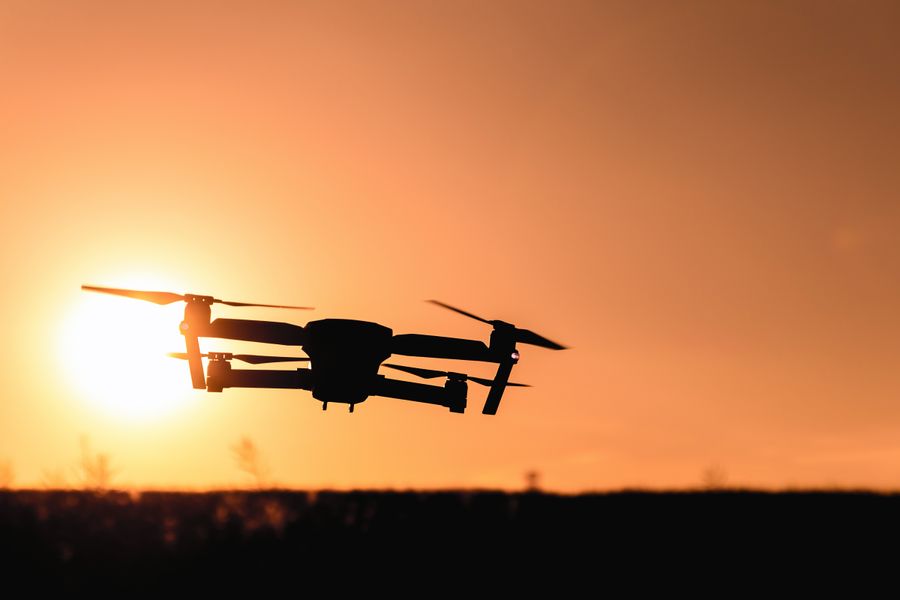
The swarm must operate fully autonomously from takeoff command to mission end. External manual intervention (except emergency stop) results in disqualification.
Vehicle-to-Vehicle communication between drones is mandatory. Drones must share position, sensor and mission data for coordination. Developing a custom protocol earns bonus points.
Each drone must carry a mechanical drop mechanism simulating a 100 g "Emergency Aid Kit" and must have fully enclosed propeller guards (prop-guards).
Teams are given a total of 10 minutes. The mission consists of 4 stages.
The swarm takes off autonomously from the launch zone and enters a random geometric formation (triangle, ring, etc.) assigned by the jury. The formation must be held for 10 seconds.
The swarm enters the "Ruined City" simulation zone. Swarm members disperse across the area and autonomously scan it to generate a 2D/3D map. Anti-collision between drones is critical at this stage.
The swarm autonomously detects 5 hidden "survivor" targets (heat signal or QR code) in the mapped area. Drones share target coordinates within the swarm, and the swarm collectively decides which drone delivers an aid kit to which target.
After all missions are complete, swarm members return to the launch zone in coordinated fashion and perform autonomous landing.
Mission stages, coordination and software bonus make up the total score.
Takeoff success and geometric formation quality are evaluated.
How much of the area was autonomously scanned and map quality are evaluated.
10 Points for each of the 5 hidden targets. Autonomous detection and location accuracy are evaluated.
Coordinated kit drop operation. 10 Points for each successful delivery.
Overall swarm fluidity, task allocation and collision-free flight performance are evaluated.
Coordinated and safe return of all drones to the launch zone and landing.
The team's custom swarm algorithm and communication protocol are evaluated by the jury.
Points are deducted for each collision between swarm members. A collision indicates a failure in swarm coordination.
Each collision: -20 PointsPoints are deducted for each contact a drone makes with course obstacles or simulation structures.
Each contact: -10 PointsIf manual intervention is applied to drones during the mission, the round is cancelled and no points are awarded.
Round CancelledTake your place on the most prestigious stage of the Atlantia STEM Olympiad with your autonomous swarm intelligence.