Sub-Category · Science & Innovation Competition
From satellite systems to rocket engineering, Mars habitat design to deep space communications — the space engineers of tomorrow are trained here.
The Space Technologies category invites students to develop projects across a wide spectrum — from satellite engineering to rocket propulsion systems, planetary exploration vehicles to space habitat design.
Teams will design, prototype and simulate innovative solutions inspired by real-world space missions. Throughout the project, you will engage with interdisciplinary topics such as orbital mechanics, thermal control, communication systems and life support technologies.
This category combines curiosity, engineering skill and scientific thinking to prepare participants to become pioneers of the space age.
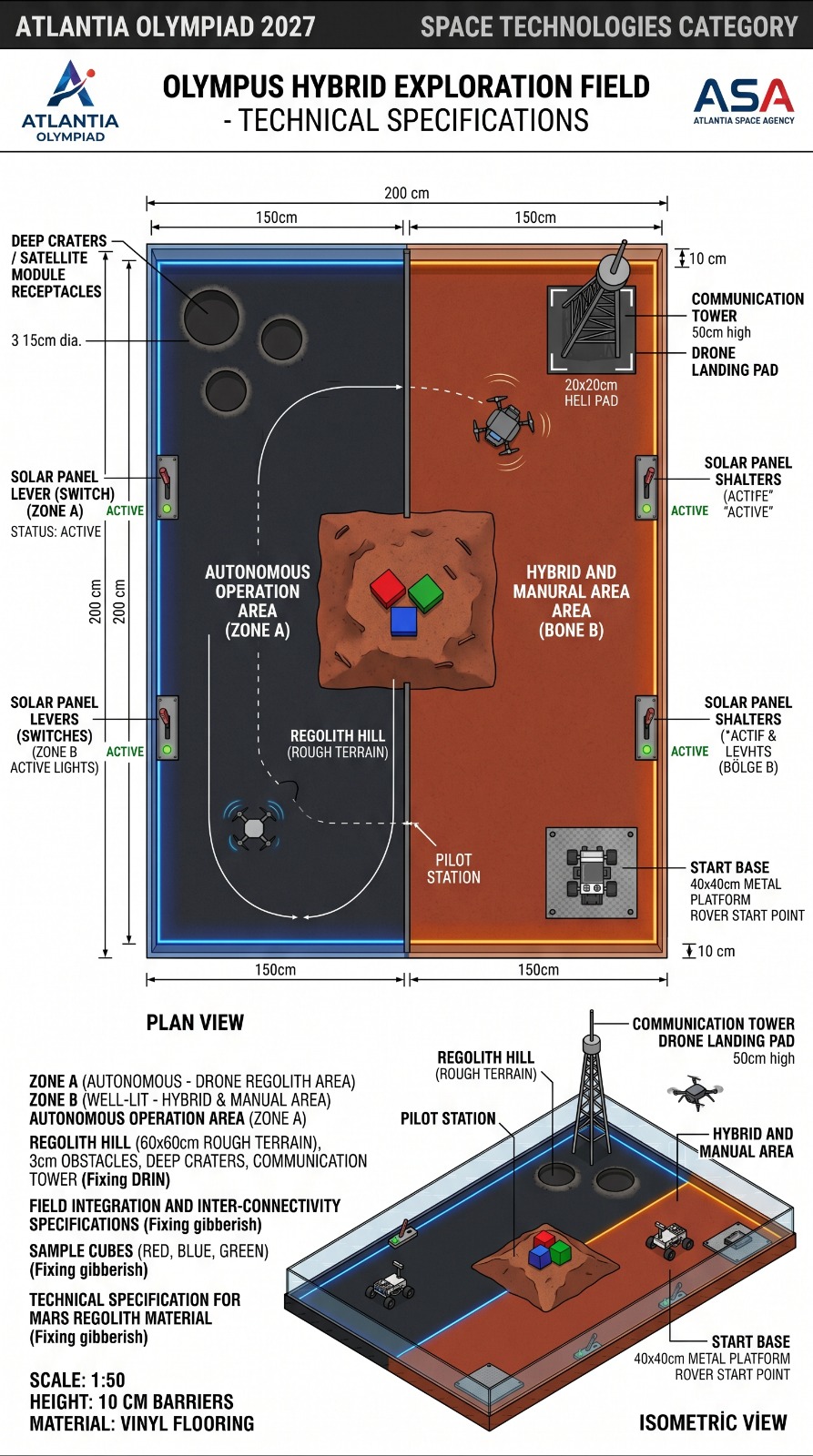
Teams can develop a project covering one or more of the following areas.
Projects on solid/liquid fuel rocket engines, hybrid propulsion systems, fuel optimization and launch simulations.
CubeSat design, remote sensing, orbital calculations, solar panel arrays and satellite communication protocols.
Mars rover design, autonomous navigation algorithms, terrain analysis sensors and sample collection mechanisms.
Lunar or Martian base concepts, life support systems (air, water, food cycles), radiation protection and 3D-printed construction.
Solar power in space, radioisotope thermoelectric generators (RTG), wireless power transmission and energy storage solutions.
High-latency tolerant protocols, laser-based space communication, antenna design and interplanetary data transfer systems.
Projects must be entirely designed by the team; off-the-shelf kits or purchased modules cannot serve as main components.
Projects involving rockets or propulsion systems must comply with all safety protocols; flammable/explosive materials must not be brought to the venue.
The design process, engineering decisions, test data and results must all be explained in detail in the technical report.
All stages from application to finals.
Teams register on the online platform and submit their project topic and a short vision summary (500 words).
The jury evaluates submitted technical reports based on scientific validity, innovation and feasibility criteria.
Selected teams develop their physical prototypes or digital simulations and collect test data.
Teams present their projects to the jury, followed by a technical Q&A session.
Final scoring across all criteria is conducted, and winning teams receive their awards.
Projects are evaluated out of 500 total points based on the following criteria.
| Criterion | Weight | Detail |
|---|---|---|
| Design Quality | %25 | Engineering approach, system integration, balance of aesthetics and functionality. |
| Technical Depth | %20 | Correct application of physics and engineering principles, consistency of calculations. |
| Innovation | %20 | Original ideas, unconventional solutions, inspiring vision. |
| Feasibility | %15 | Real-world implementation potential of the project, cost and technical feasibility. |
| Presentation | %10 | Communication skills, quality of visual materials, answers to questions. |
| Technical Report | %10 | Report scope, use of scientific language, references and data presentation. |
Must be presented as a 3D model, working prototype or digital simulation (CAD, Simulink, KSP, OpenRocket, etc.).
Max. 20-page report covering the project purpose, design process, engineering decisions, test data and results.
A 3-minute introductory video for the preliminary stage showing the working project and team vision.
Simulation outputs, test results, performance graphs and comparative analyses submitted digitally.
Apply now to showcase your engineering skills and space vision on the international platform.